INGEO was involved in a lot of biomechanics articles. This term refers to the behavior of a prosthesis (hip, knee, teeth, spine, shoulder, hand) during its normal operation in the human body.
INGEO initiated several collaborations about scientific research on biomaterials and biomechanical behavior of implants (especially dental implants).
Here are presented some italian research and publications by the PhD Luigi Paracchini concerning biomechanic.
| Different geometric patterns of pacifiers compared on the basis of finite element analysis |
Top |
This study was carried out with file purpose to show on a virtual model of oral cavity the mechanical behaviour of different kinds of pacifiers with . different pressure levels that can be likened to a condition of the rest and deglutition.
 |
L. Levrini (1), P. Merlo (1), L. Paracchini (2)
(1) University of Insubria, Varese, ITALY
(2) INGEO Snc, Varallo Pombia (NO), ITALY
European Journal of PAEDIATRIC DENTISTRY, 4/2007 |
|
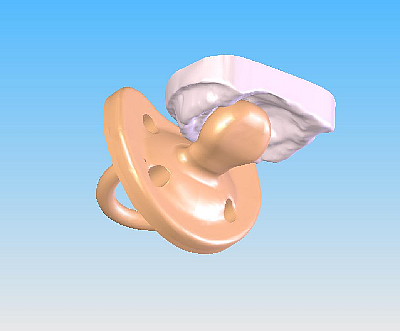
3D model of pacifier
(Click here to have more information) |
--------------------------------------------------------------------------------
| Impianti corti: principi biomeccanici e predicibilità a lungo termine |
Top |
The efficacy and reliability of an implant design to biocompatibly transfer the occlusal forces on its prosthetic restoration to its surrounding bone is a significant engineering challenge. The BICON® short implant is an example of a time proven geometric design that successfully transfers the occlusal forces on its prosthetics to its surrounding bone by appropriately integrating the following features: a bacterially-sealed, 1.5 degree locking taper abutment to implant connection and a sub-crestally placed, sloping shouldered implant with a plateaued tapered root form body.
|
M. Marincola (1), L. Paracchini (2), V. Morgan (3), J. Schulte (4)
(1) Università di Cartagena, Libero professionista, Roma, ITALY
(2) INGEO Snc, Varallo Pombia (NO), ITALY
(3) Implant Dentistry Center, Boston, USA
(4) Università di Minesota, USA
Quintessenza Internazionale Sett.-Ott. 2008, 45-53 |
|
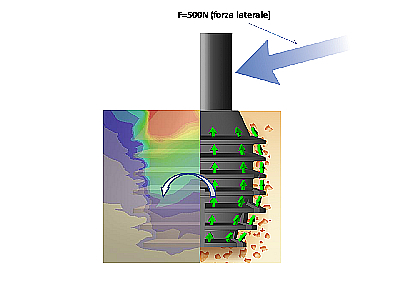
von MISES stress on dental implant vs bone |
--------------------------------------------------------------------------------
| 3D finite element analysis to detect stress distribution: Spiral family implants |
Top |
Spiral family implants are a root-form fixtures with increasing thickness of tread. This characteristic gives a self-tapping and self-condensing bone properties to implants. To study spiral family implant inserted in different bone quality and connected with abutments of different angulations a Finite Element Analysis (FEA) was performed.
|
M. Danza (1), S. Fanali (1), I. Zollino (2), R. Guidi (2), F. Carinci (2), L. Paracchini (3)
(1) Dental School, University of Chieti, ITALY
(2) Maxillofacial Surgery, University of Ferrara, ITALY
(3) INGEO Snc , Varallo Pombia (NO), ITALY
J. Maxillofac Oral Surg 8(4): 334-339 |
|
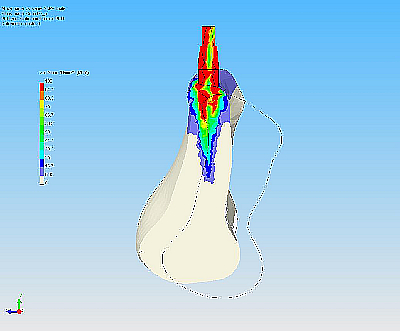
von MISES stress on mandible loaded of dental implant |
--------------------------------------------------------------------------------
| 3D finite element analysis comparing standard and reverse conical neck implants - Bone Platform Switching |
Top |
Biomechanical optimization is an important objective in the design of dental implants. Finite element analysis (FEA) has become an increasingly useful tool for predicting the biomechanical stress on an implant and the surrounding bone. The components in a dental implant-bone system are geometrically complex. The use of FEA in implant biomechanics offers many advantages over other methods when it comes to simulating the complexity of clinical situations. FEA facilitates predictions of stress distribution in the contact area between implant walls and cortical bone and between the apical aspect of the implants and trabecular bone. Although the success rates of some implant systems have been high, implant failures do occur.
|
M. Danza (1), l. Zollino (2), F. Carinci (2), R. Guidi (2), L. Paracchini (3), l. Vozza (4)
(1) Dental School, University of Chieti, ITALY
(2) Maxillofacial Surgery, University of Ferrara, ITALY
(3) INGEO Snc , Varallo Pombia (NO), ITALY
(4) Dental School, University of Rome "LA SAPIENZA",, ITALY
EDI Journal, 2 (2010): 334-339 |
|
3D model of the bone and dental implant |
--------------------------------------------------------------------------------
| 3D finite element analysis comparing standard and reverse conical neck implants - Bone Platform Switching |
Top |
| To study a spiral family implant by finite element analysis (FEA) inserted in mandible, connected with straight abutment and located with vertical and lateral forces. The biomechanical behavior of 5mmx13mm ULTIMATE dental implant (AoN Implants, Grisignano di Zocco, Vicenza, Italy) connecting screw, straight abutment subjected to static loads, in contact with mandibular bone was evaluate by FEA. Stress and strain values of fixture are comparable to those obtained by analyzing different spiral implants. These implants can be used in mandibular bone. However, clinical studies are needed to verify the reported results. |
M. Danza (1), L. Paracchini (2), F. Caringi (3)
(1) Dental School, University of Chieti, ITALY
(2) INGEO Snc , Varallo Pombia (NO), ITALY
(3) Maxillofacial Surgery, University of Ferrara, ITALY
DENTAL CADMOS , 2012; 80(10): 598-602 |
|

|
Stress distribution in implant loaded
--------------------------------------------------------------------------------
| Comparazione biomeccanica di 3 materiali usati per barra "Fixed on Short" |
Top |
| In this article the biomechanical behavior of three different materials in terms of physical and chemical properties used for a beam on four ultra-short dental implant inserted into atrophic bone were studied. |
L. Paracchini (1), M. Marincola (2)
(1) INGEO Snc, Varallo Pombia (NO), ITALY
(2) Direttore scientifico BICON DENTAL IMPLANTS
Quintessenza Internazionale Anno 29, 3bis, 2013, 45-53 |
|

|
Stress distribution on the mandible with loaded beam
--------------------------------------------------------------------------------
| Evaluation of biomechanical effects of interocclusal surface on the mandible |
Top |
| Only few studies in the literature employ a mathematical model in the evaluation of the stress which follows the application of loads and constraints onto the mandible. Therefore, new approaches are needed so that the study of this phenomenon can rely less on the clinical hypothesis and experience of the operator, while taking advantage of the many benefits that virtual representations and mathematical calculations present. Aim of the study is to determine, by means of the finite element method (FEM), the stress produced onto the mandible as a result of the application of a force on itself, in association or not to the perioral musculature and according to the dental support given by the positioning of an interocclusal surface at three different levels: mesial, intermediate and distal. The aim is to allow a more objective evaluation of this phenomenon, its absolute repeatability, as well as to acquire important clinical informations concerning the role of orthodontic and gnathologic appliances. |
L. Levrini (1), L. Paracchini (1, 2), C. Mangano (1), L. Pisani (1), A. Caprioglio (19
(1) University of Insubria, Varese, ITALY
(2) INGEO di Paracchini Luigi, Varallo Pombia (NO), ITALY
SEOJODR October 2015; (2) 27-34 |
|

|
Distal support A1 in association to the perioral musculature
--------------------------------------------------------------------------------
For further informations about Biomedical research, please contact PhD Luigi Paracchini, phone number +39 0321 921654 (during office hours), or send an email to info@ingeosnc.it
|